A lot has happened since the 2017-2018 academic year. I’ve changed positions at MSU Denver, but for a very good reason: I was denied tenure under dubious (read: discriminatory) circumstances. I was threatened by the chair of the Retention/Tenure/Promotion (RTP) committee and the chair of my department, and the tenured faculty chose to evaluate me under terms and conditions that did not exist in the department bylaws/guidelines, and under terms that the American Association for University Professor deems dangerous. On top of this, I was the only faculty member evaluated in this fashion. All other faculty going up for tenure were not evaluated in this fashion. Coincidentally(?) the other tenure candidates were Caucasian – I am not. The people that worked to deny me tenure, using a metric that did not exist for any other faculty being reviewed, were Caucasian. In my department, the only person who believed I deserved tenure, and advocated for me, is African American. He is the only African American in my department, and the only other non-Caucasian tenure/tenure-track faculty in the department.
Discrimination against Asian/Asian-American faculty is nothing new. Just as a recent example: there is an ongoing lawsuit against Michigan State University based on discrimination against Asian/Asian-Americans.
I am confident that a lot of this stems from the immense bullying I experienced at the hands of a senior organic chemistry faculty member (also white). I filed an official complaint, the complaint was investigated on a timeline that violated the handbook for professional personnel due to the lack of a firm and clear anti-bullying policy for the university, and I was ultimately vindicated. However, adjudication only came in the form of a stern warning letter, and a edict that the bully could not be a part of any of the evaluation process for my career. The mandate was also kept confidential, which I found objectionable: a bully should be outed so that others will know and be prepared to defend themselves should they be required to interact with the bully.
Overall I believe that what transpired was a gradual shift in the department faculty that indicated that the lack of announcement of the original bullying investigation verdict – that I was a target of intense bullying, had led to a shift in attitudes towards me. If there was no punishment for the bully, then clearly the target is “making this up.” My requests through the dean and provost to be protected from retaliation were honored, but at the department level, my requests for protection were met by the chair of the department in a lukewarm fashion. Towards the end of that year, requests were being entertained, but couched with “sage advice” of the kind that made it clear the chair was tired of entertaining my desire to work in a safe and protected environment. I was being repeatedly told, “this kind of behavior ends academic careers,” or “you need to be out there more with the faculty – you can’t just sit behind a closed door.” At the time, I kept my mouth shut because the desire to achieve tenure made me hesitant to object – but in the department, three other faculty worked behind closed doors on a regular basis. I alone was singled out as being “problematic” for doing so. And yes, all three of those faculty were white.
Again, this happens in the academy quite a bit. Research has shown that bullying in the workplace is pervasive, and editorials from high profile journals are now attempting to address the elephant in the room of bullying in the academy specifically; and I have no doubt that at the institution I worked at (that I continue to work at, albeit in a different program now) had a pervasive bullying problem. Retaliation against faculty is not unheard of – and bullying by an organization of people, i.e. mobbing, is a natural extension of bullying by an individual in an organization. And in fact, the last year that I was a faculty member of the chemistry department, I was actively being mobbed by multiple faculty. The departmental response was not to take a step back and try to evaluate how to put an end to the mobbing. Instead, the departmental response was to actively condone the mobbing, as well as participate in the behavior using the tenure process to coerce me into behaving in a fashion that was deemed “collegial” by the chair of the department and tenured faculty. It went so far as to lead to a meeting between myself, the chair of the RTP committee, and the (then) ombudsperson for the university. At the meeting I was told by both the department and RTP Committee chairs, “if you do not withdraw your application for tenure, and you fail to get tenure, your future reviews will be prejudiced against you.” I chose to advocate for myself, and this culminated in being denied tenure.
Officially, on paper, I was deemed to be “not meeting standards of teaching,” with the justification of this being the number of negative student comments in my contemporaneous reviews during the year. When compared to quantified metrics, I showed continual improvement and met guidelines for department standards (or exceeded them), and was even noted as having done so. However, what mattered most was that students said mean things about me. It did not matter that I had an overwhelming majority that had nothing but praise. The fact that there was a “significant share” of comments that were openly hostile towards me was all that mattered. It didn’t matter that my students continued on in the departmental offerings successfully. It didn’t matter that negative subjective comments were not a metric that could be used against me based on the departmental and university guidelines. It didn’t matter that students authored a petition to have me tenured because of my enthusiasm for teaching, and the amount of time and energy I devoted to them to ensure they were being afforded the best instruction I could muster. As long as there were negative student comments, I would never be seen as meeting guidelines for teaching.
As soon as my review process left the department, the review committees could very clearly see what had happened. At the college level, the committee noted that I was being evaluated in a way that had no precedent or basis in the department guidelines. It was, for all intents and purposes, arbitrary. Subsequent reviews up to the provost’s review all followed the same sentiment: I met standards based on the guidelines set forth by the department, and I should be granted tenure. At the provost level of review, the provost is allowed to call a reconciliation meeting: a meeting between chairs of multiple levels of review to determine a level of consensus. Naturally, the chair of the department was there – and I was informed that the provost made a decision based on the argument that the negative subjective students are reliable and that those types of review are a viable means of evaluating professors.
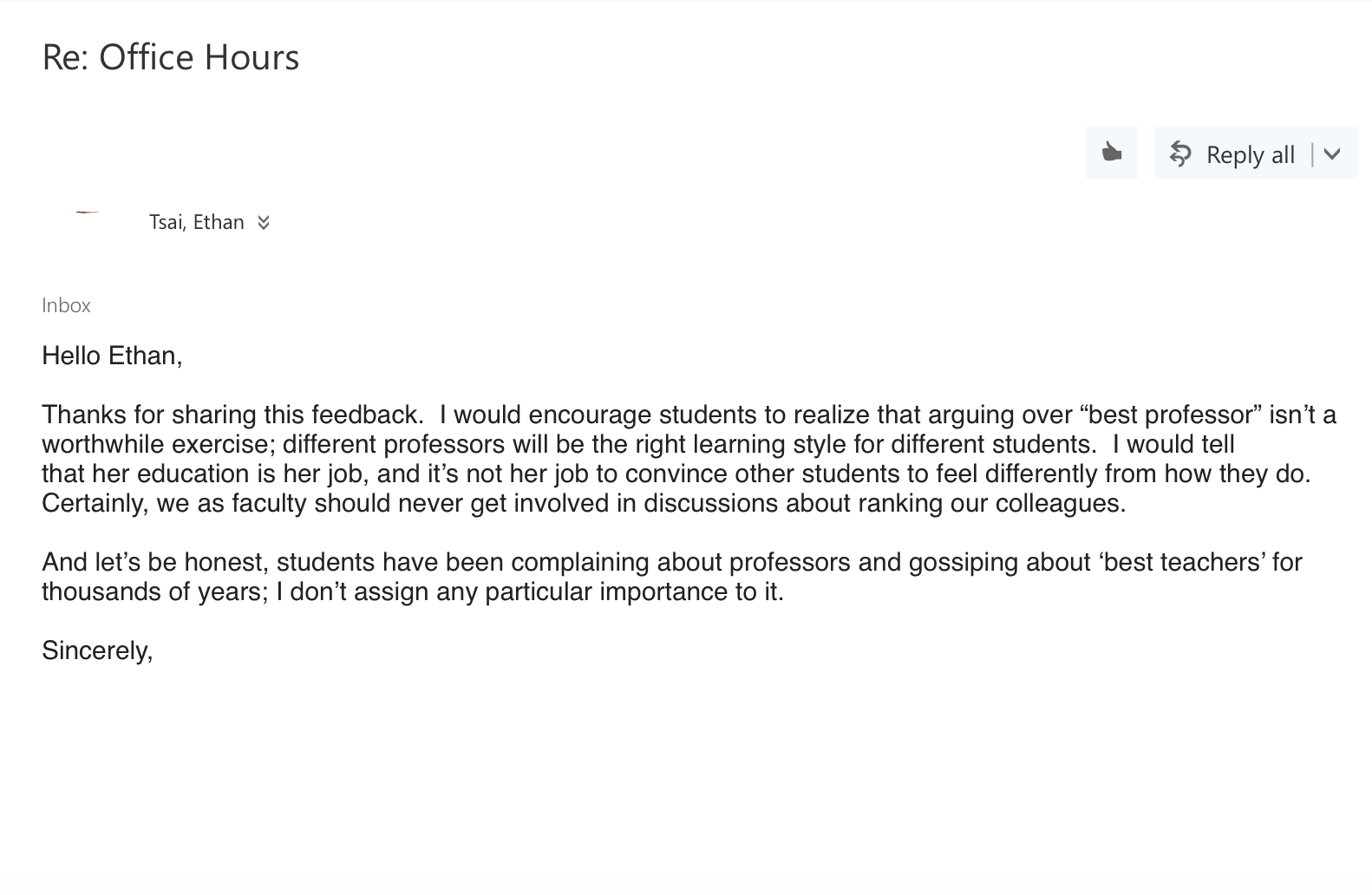
This is troublesome for a variety of reasons, chief among which is that research has shown that negative subjective student comments are absolutely unreliable as a means of objective evaluation of instructor value. No other professor in my department was ever evaluated on the basis of negative student comments. One could object and say that the other professors had no negative student comments, but what is most important is that I was informed by the chair of the department via email that he did not assign any importance to “student complaints.” The hypocrisy then, in informing a faculty member trying to gain tenure that negative student comments are not important, and then denying tenure based on negative student comments, is fairly obvious.
So where does the discrimination come in? I think it’s safe to say that the people involved in denying me tenure were influenced by racial bias unconsciously. Those people involved will not admit to allowing race to factor into the decision, or are even willing to acknowledge that it may have unconsciously factored into the decision, but the fact that my evaluation by the provost and department was rooted in something so arbitrary – and something that was never applied to any caucasian faculty from my department undergoing the same evaluation speaks volumes.
You can see the review letters (and my responses) below:
- Department RTP Review Letter
- Department Chair Review Letter
- College Level RTP Review Letter
- Dean Level Review Letter
- Faculty Senate RTP Review Letter
- Provost Review Letter
Ultimately, I was denied tenure, and it was made clear by the chair of the department that I had no future in the chemistry department. When he would “stop by for a chat” in my office, he would always ask pointed questions about “moving on” and “future plans outside of chemistry.” I didn’t feel welcome in the department any longer, and as soon as the review process was underway, all of the tenured faculty in the chemistry department immediately isolated me from their daily activities – a move I did not object to, but certainly seemed odd given that I was being criticized for not being more “collegial.” Being left alone was fantastic for me mentally, but it also highlighted the fact that the faculty were very united in ostracizing me. There were a couple of occasions where faculty tried to provide me a gift to make it seem like everyone was still friends, but these involved poop emoji items – how was that meant to make me feel better? I am viewed as poop by the faculty?
Luckily, I had cultivated a close working relationship with the Beer Industry Program faculty, and proposed the idea of moving into that program full time. The idea was readily advocated for, and with help from the people from Tivoli Brewing Company, I was quickly shuttled into the Beer Industry Program in the new School of Hospitality, Events, and Tourism. I am lucky that I was able to escape the people who actively participated in mobbing me and bullying me. I haven’t touched on the ways in which my research students were also subjected to bullying by faculty, but suffice it to say, they were. It was an incredibly hostile working environment, and it pains me that there are untenured faculty that I remain close friends with, that still remain in the department. I hope that by the time they are applying for tenure, the process has been rectified and made fair for any future faculty member.